
Planning For Planned & Legacy Gifts
By Brandon Allen
Executive Director | Fortify Foundation
There are some things in life that we know will most likely never happen unless we intentionally plan for them.
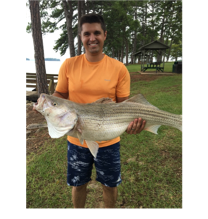
I’ve shared before that one of the biggest striped bass I ever caught was with my bare hands. On top of that, it came from a local lake where I’ve historically had some of the worst luck catching fish.
When I show people the picture, their jaws usually drop at how big it was and immediately want to know how in the world I managed to catch it with my hands.
Well, there’s a little more to the story.
We were out on the lake for our church’s annual “Teen Lake Day”. As we were pulling tubers, I noticed something rather large floating on the surface. It was big enough that I decided to take a break from the activity at hand and swing the boat around to investigate.
Sure enough, the quick change in plan was well worth it. We couldn’t believe how big this fish really was!
I asked the teen boys to grab it and throw it onto the back of the boat. Not one of them was willing to touch it. (This is teen boys! Can you believe that??)
So, I had to manage maneuvering the boat while grabbing the fish, eventually bringing it to shore, where the rest of the teens / staff all basked in its size.
It doesn’t take an avid fisherman to figure out that this isn’t the typical way you catch a trophy fish.
Sometimes success simply floats our way. But most of the time, accomplishing something meaningful requires a plan, the right tools, and intentional action.
The same is true of planned giving.
I wish I had concrete historical data showing how many K–12 Christian schools have received planned gifts, but anecdotally, I’ve found that it is certainly not the majority.
Why is that?
Is it because our missions aren’t worthy of these gifts? Is it because our constituents aren’t willing to give them? Or could it simply be that many of our donors have never been made aware of the opportunities available to them?
When a school does receive a significant planned gift, it is most likely because a forward-thinking attorney, CPA, financial advisor, or other professional helped a donor understand how charitable giving could fit within his or her broader financial and estate plans.
That raises an important question:
What if our schools became more intentional about starting those conversations?
For many donors, the majority of their wealth isn’t sitting in their wallets or bank accounts. It may be held in retirement accounts, investments, real estate, businesses, life insurance policies, and other appreciated assets.
Yet when many schools ask for gifts, we focus almost exclusively on cash.
Why?
Because that’s the way we’ve always done it and up to this point, it has seemingly worked.
But what if we started to cast a wider net?
Before going any further, the goal of shifting our strategy should not be to squeeze more money out of our donors or simply gain more for the school.
It is quite the opposite!
The goal should be to serve our donors better and to help them understand additional ways they may be able to support a mission they already care deeply about while potentially realizing financial, estate-planning, and tax benefits along the way.
What Is a Planned Gift?
Planned giving is a strategic approach to charitable giving that incorporates a donor’s broader financial, tax, retirement, or estate planning.
It is commonly associated with gifts made through wills and trusts, beneficiary designations, retirement accounts, life insurance policies, charitable trusts, and other estate-planning strategies.
The broader conversation should also include asset-based giving during a donor’s lifetime. Appreciated securities, real estate, business interests, cryptocurrency, vehicles, collectibles, and other non-cash assets may provide opportunities for donors to make meaningful gifts without simply writing a check.
In other words, we need to help donors think beyond:
“How much cash can I give?” and begin considering: “What has God entrusted to me, and how can I use those resources to make an impact?”
How Do We Plan for It?
Well, just like fishing, we must be intentional! We need a strategy!
Ultimately, we are all in the education business. Christian schools do an incredible job educating and training the next generation for Christ. Perhaps, we also do a pretty good job educating parents along the way.
But when it comes to charitable giving, we often fail to educate the very people who want to support our mission.
If donors don’t know that they can give appreciated stock, name the school or its endowment as a beneficiary, make certain gifts from retirement assets, donate real estate, or include Christian education in their estate plans, how can we expect them to consider those opportunities?
Education has to come before expectation.
What Difference Could It Make?
There are two sides to this question.
Side #1: The Donor
Planned and asset-based gifts can allow donors to make a larger and more lasting impact while potentially providing meaningful financial or tax benefits.
Depending on the donor’s individual circumstances and the type of asset involved, giving appreciated assets may provide advantages beyond making the same gift with cash.
More importantly, it allows donors to align their financial and estate plans with the causes and ministries they care deeply about.
We’re not simply asking donors to give more.
We’re helping them discover opportunities to give differently… and sometimes more effectively.
Side #2: The School
For the school, planned giving creates an opportunity for grandparents, alumni, parents, and friends to make an impact both today and for generations to come.
Some gifts may provide immediate resources. Others may eventually become transformational legacy gifts.
And when those gifts are directed toward an endowment, they can continue supporting Christian education year after year.
We’ve now created opportunities for both today’s gift and tomorrow’s legacy.
What Should We Expect?
There is a well-known phrase that states, ‘we should never expect what we aren’t willing to inspect.’
Donors aren’t always going to jump into something they haven’t previously explored or understood. And as with any major gift, there must be a conscious effort to establish meaningful relationships and trust before making an appropriate ask.
Certainly, something as simple as educating donors about giving appreciated stock may produce some immediate opportunities.
But that’s just casting a single line.
The bigger goal is to develop a culture in which donors regularly hear about the many ways they can support the mission.
Understand that this takes time.
Planned gifts, particularly those connected to estate plans, may take years before they are ultimately realized. That means we can’t host one seminar, hand out a couple of flyers, and expect transformational gifts to suddenly appear.
Planned giving must become part of the school’s long-term development strategy, with a continual flow of information that educates and equips donors to consider gifts of this nature.
For most schools, this strategy won’t replace what you’re currently doing. It will complement it.
Annual giving still matters. Capital campaigns still matter. Major gifts still matter.
We’re simply widening the net.
Because while it’s possible for a trophy fish to unexpectedly float our way, that’s probably not the fishing strategy we want to depend on.
The same is true of planned gifts.
Schools shouldn’t simply hope planned gifts happen. We should educate our donors, build relationships, provide giving opportunities, and create a strategy that make them possible.
At Fortify Foundation, we help Christian schools do more than manage their endowment funds. We also provide resources and strategies designed to help schools educate donors, communicate giving opportunities, and prepare to receive planned and asset-based gifts.
An endowment can provide a powerful destination for those gifts and an opportunity for today’s generosity to support your school for generations to come.
After all, we’re not simply trying to catch more fish. We’re trying to become better stewards of every opportunity God provides.

Brandon Allen is the Executive Director for Fortify Foundation. Fortify is a strategic ministry partner formed exclusively to benefit Christian education. Brandon, and the Fortify team, is ready to help you, your donors, and stakeholders through fundraising, capital campaign management, and endowment support to benefit your short and long-term financial goals.
As you explore the concept of endowment, I would love to have a conversation with you about how this can create a more sustainable future for your school!
Contact Brandon at 803-615-3037 ext. 1 or Click HERE to schedule a call.