
By Dr. Brian Simmons
Introduction
Strategic planning is determining in advance a strategy of action toward a desired objective. It has been saidthat failing to plan is planning to fail! A corollary to this truism is organizations that need strategic planning the most do it the least and those who need it least do it the most!
Strategic planning is analogous to way-finding. Wayfinding is the cognitive, informational, and physical process of navigating, orienting, and traveling from one place to another within an environment.
Years ago, I led weeklong canoeing and backpacking trips in the Algonquin Provincial Park in Canada for student leaders of the Christian schools I led. The plan for the week was to begin at Canoe Lake and work as a team to experience a grueling loop of portages connecting large and small lakes with spectacular experiences along the way then return safely back to Canoe Lake in seven days. I’m the young man in the red shirt in the middle of this picture!
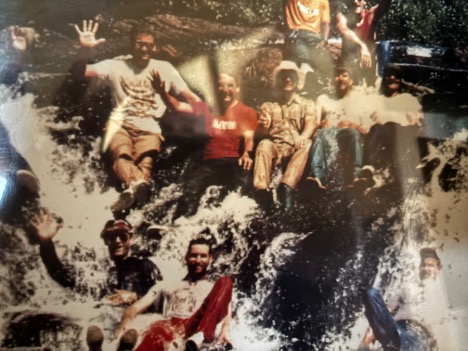
As we set out for the week, I would regularly take out my map and compass to orient our direction to our daily destinations. This set of daily destinations ultimately led us back to our starting point. Each day, our waypoints were 8” X 12” yellow portage signs nailed onto trees marking trailheads, and at the end of the day designated camping sites marked by similar orange signs nailed onto trees on small islands. It made for a L-O-N-G day if we missed one of these signs! And the sobering reality was that without these signs a map and compass we had no chance of arriving at our desired destination… ever!

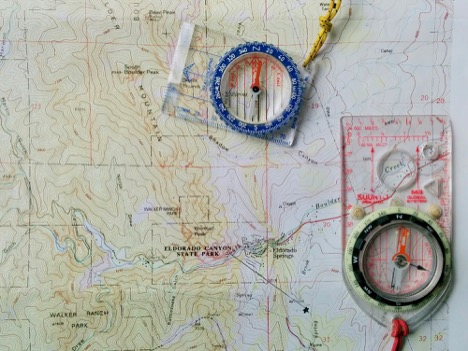
Orienting your direction with a map and compass means aligning the map with the real world so you can accurately determine where you are, which way you’re facing, and where you need to go. This is important in the wilderness so that you don’t get lost and instead can find your way to your desired destination! This is also important for organizations! Let me explain.
The Reasons for a Strategic Plan… in simple terms
Orienting your direction with a map and compass means making the map line up with the land, so the map becomes a true picture of what’s around you—and you can confidently choose and follow the correct direction.
Failing to orient your map and compass means you’re navigating with a distorted picture of reality. What you think is “forward” may not actually be forward… turning a simple journey into a dangerous situation. If you fail to orient your direction with a map and compass, several problems can happen—ranging from minor confusion to serious danger. You may walk in the wrong direction. You can misidentify landmarks. Small errors become big problems. You risk getting lost. You can miss out on awesome experiences. Safety risks increase (i.e., those you lead can get hurt), and rescue becomes harder (i.e., it is harder and harder to turn a floundering organization around).
Roles of the Board and CEO
Boards and CEOs need to regularly meet together with compass and map in hand to engage in financial, strategic and generative discussions about the preferred future of the organization and how best to get there taking into consideration both internal (strengths and weaknesses) and external (opportunities and threats) data (i.e. facts about the lay of the land)!
In best practice, it is the board that sets the strategic direction with the CEO, and it is the CEO and his/her team who work together to execute the plan. It is the CEO paddling at the front of the canoe armada who leads the team to arrive safely and well fed at the desired location while experiencing pre-established goals along the way.
An Epiphany
A strategic plan is a tool for board members to use to set direction for an organization, fulfill the mission, vision, and SMART goals and to keep the organization from danger. As I thought about this, I had an epiphany! A board cannot fulfill its primary responsibilities without a strategic plan!! And a head of school cannot effectively lead the day-to-day operations of a school without a strategic plan!
In my experience, school boards without a map and compass trade important strategic leadership for intrusions into operational work. Or worse, they disengage entirely and defer to the CEO. These intrusions harm the relationship of the board and head of school due to issues surrounding role confusion (who does what, how and when). This role confusion muddles the direction of the organization, strains relationships, and in the process destroys organizational effectiveness.
A head of school without a strategic plan, wanders from one crisis to another throughout the day. This behavior replaces the important with the urgent.
Micromanagement by the Board
When board members become too heavily involved in daily operations, decision-making comes to a screeching halt as people and their wills collide. This undermines the authority of the CEO, and as a result senior leaders are confused about who to follow. This behavior creates thick politics as the battle rages over who makes operational decisions.
Laissez-Faire Board
The opposite problem occurs when the CEO controls the board via abuses of informational, situational, coercive, legitimate and reward power. When this happens, the board becomes passive or symbolic and board members defer excessively to the head of school and other school leaders.
Resulting Problems
If performance suffers, stakeholders are left to wonder who was responsible for the organizational failure. And this generates a whole host of questions. Did the board fail in oversight? Did the CEO fail in execution? Were expectations clearly defined?
How a Compass (strategic plan) works in a Christian school
On earth where all people live, the only reason a compass works is because there is a magnetic north! Without this, the needle of the compass would be useless.
For followers of Christ, we recognize that God is our magnetic north, and we have a great gift from God- the indwelling Holy Spirit who guides believers into truth! So, we have an effective compass and a guide we need to follow!
The Map We Choose to Follow
God is the ultimate owner of the organizations He has entrusted to our care! So, as faithful steward leaders, we need to seek His purposes for the organizations we lead before we attempt to move others onto His agenda! In other words, we need to orient our wills to His will! As organizational leaders, His will is the map we orient our direction to! We don’t adjust the map to fit our desires. We orient our direction to God’s will for the organizations we lead! Then, as organizational leaders, we align our behaviors which accompany the respective roles we play with His direction for the schools we lead together for His glory and our good!nd boldly. When we do, we move from scarcity to abundance, from survival to sustainability, and from good intentions to lasting impact.Let’s lift both arms. The mission depends on it

By Dr. Brian Simmons
With over 40 years of experience, Dr. Brian Simmons exists as a visionary builder to further the kingdom of God through Christian education, teaching and influencing others. He has served as an advancement director, head of school, ACSI president, and VP of CIU Global. He is currently the founding head of Lakeside Christian Academy.